
In a significant milestone for India’s rapidly maturing spacetech ecosystem, Bengaluru-based startup The Guild—formerly known as EtherealX—has raised $20.5 million in Series A funding, pushing its valuation to $80.5 million. The round was co-led by TDK Ventures and BIG Capital, with participation from prominent investors including Accel, Prosus, YourNest, Campus Fund, BlueHill, and Riceberg.
With this raise, The Guild’s total funding now stands at $25.5 million, marking a dramatic 5.5x jump in valuation and signaling growing investor confidence in the company’s audacious vision: building the world’s first fully reusable medium-lift launch vehicle and redefining the global cost baseline for access to space.
A Signal Moment for India’s Spacetech Ambitions
The funding arrives at a time when India’s private space sector is transitioning from promise to performance. Over the past decade, investment in Indian spacetech has accelerated sharply—rising from modest levels between 2010 and 2019 to triple-digit million-dollar inflows in recent years. Backed by regulatory reforms and government initiatives such as a ₹1,000 crore venture capital fund dedicated to space technology, the ecosystem now hosts more than 100 active spacetech startups, many founded within the last five years.
Against this backdrop, The Guild’s Series A round stands out as a validation of both technical depth and long-term commercial ambition. The company is positioning itself not merely as another launch provider, but as a platform capable of reshaping how orbital access is priced and scaled globally.
Rearchitecting Access to Orbit
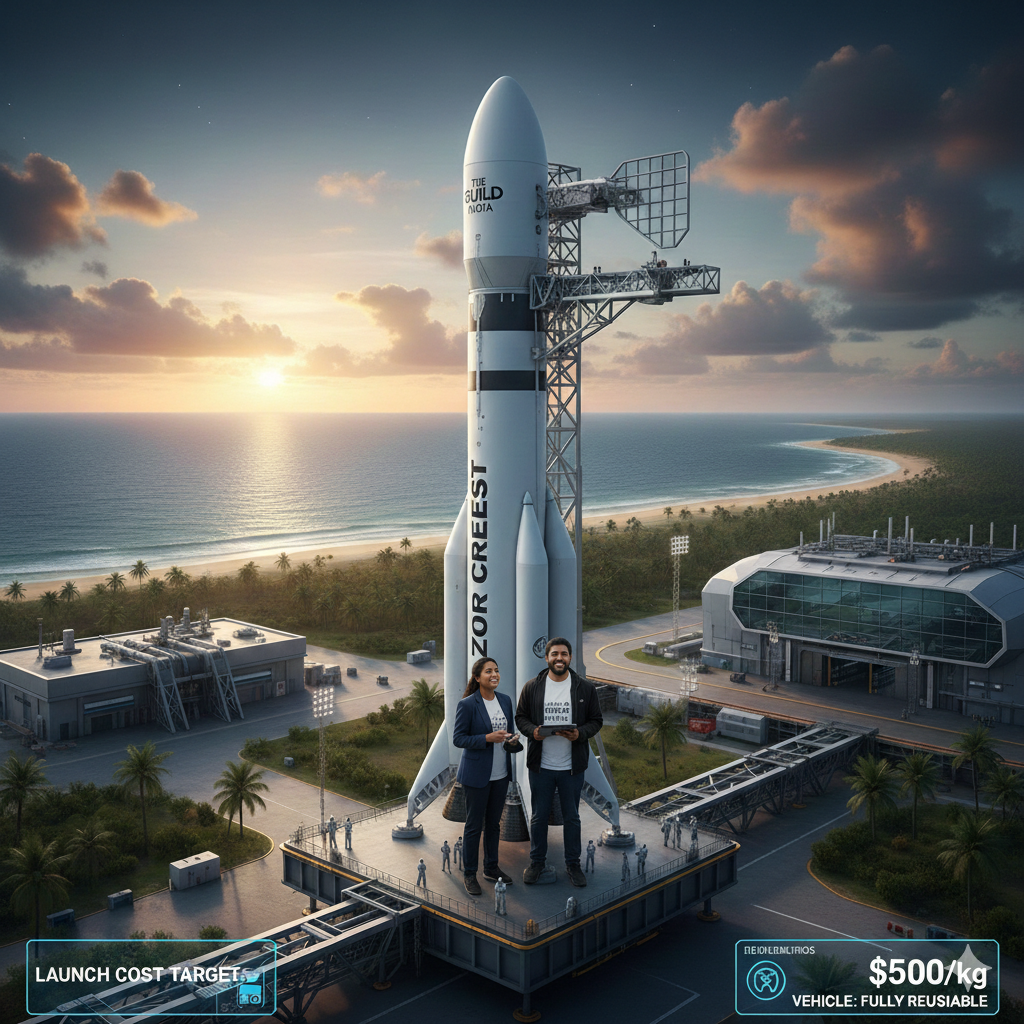
At the heart of The Guild’s roadmap is the Razor Crest Mk-1, a medium-lift launch vehicle designed for missions to Low Earth Orbit (LEO) and Geosynchronous Transfer Orbit (GTO). Unlike most rockets in operation today—which are only partially reusable—the Razor Crest Mk-1 is being engineered for full reusability across both stages.
This design choice is central to the company’s most ambitious target: reducing launch costs to $500 per kilogram. For context, traditional expendable rockets historically cost more than $10,000/kg, while even industry leaders like SpaceX’s Falcon 9 operate in the $2,500–$3,000/kg range. If achieved, the Guild’s model would represent a step-change in launch economics.
The Razor Crest Mk-1 is expected to deliver:
- Up to 24.8 tonnes to LEO
- Up to 10.8 tonnes to GTO
Such capacity places it squarely in the medium-lift category, a segment that already accounts for a significant share of the reusable launch vehicle market and is projected to grow rapidly through the next decade.
Engines Built for Reuse, Not Replacement
In just over three years since its founding in 2022, The Guild has already developed two proprietary rocket engines, underscoring its emphasis on in-house engineering.
The booster stage will be powered by “Stallion”, a 1.2-meganewton reusable semi-cryogenic engine that the company describes as the most powerful reusable engine in its class. Designed for high-thrust operations and rapid turnaround, Stallion is a cornerstone of the first stage’s reusability strategy.
For the upper stage, The Guild has developed “Pegasus,” an 80-kilonewton engine optimized for orbital insertion and return. What sets the upper stage apart is the use of a Full-flow Segregated Cooling Cycle (FSCC)—a novel approach aimed at managing extreme thermal loads and enabling the safe recovery and reuse of the second stage, a challenge that has historically limited full reusability.
Together, these engines reflect the company’s belief that true cost reduction in spaceflight will only come when every major component is designed to fly again and again.
Infrastructure to Match Ambition
To support its aggressive development and testing timelines, The Guild is scaling its physical infrastructure across southern India.
- BASE-001 (Cuddalore, Tamil Nadu) continues to serve as the company’s propulsion testing hub, particularly for the Pegasus upper-stage engine. The facility includes turbopump testing capabilities exceeding 35,000 RPM, enabling high-fidelity validation of engine subsystems.
- BASE-002 (Space City, Andhra Pradesh) is a newly commissioned, large-scale facility dedicated to integrated engine and stage firing, additive manufacturing, and flight qualification of the Stallion booster. This site is expected to play a pivotal role as the Razor Crest Mk-1 moves closer to full-stack testing.
The dual-facility approach allows parallel development across stages, reducing iteration cycles and accelerating readiness for flight.
Why TDK Ventures Matters
While the funding amount is significant, TDK Ventures’ involvement carries strategic weight beyond capital. The firm brings deep expertise in avionics, hardware optimization, latency reduction, and high-performance components—areas that are critical for reusable launch systems where reliability and rapid turnaround are non-negotiable.
According to Manu Nair, Co-Founder and CEO of The Guild, the partnership represents a broader shift in how space access is structured:
“Securing the backing of a strategic partner like TDK Ventures validates our vision to rearchitect today’s unipolar access to space into a truly multipolar frontier. Their expertise strengthens our hand as we push Razor Crest Mk-1 toward rapid development and flight qualification.”
With this support, the company believes it can meet its aggressive timelines, unlock greater launch flexibility for customers, and establish a new global cost benchmark for orbital missions.
Competition, Context, and What Comes Next
The Guild operates in an increasingly competitive Indian launch market alongside peers such as Skyroot Aerospace and Agnikul Cosmos, both of which have secured substantial funding and valuations. However, The Guild’s emphasis on full reusability across both stages sets it apart in a landscape still dominated by partially reusable systems.
Globally, the reusable launch vehicle market is projected to approach $9.8 billion by 2031, with the Asia-Pacific region emerging as the fastest-growing contributor. Demand is being driven by satellite constellations, Earth observation, defense applications, and commercial space infrastructure—markets that require frequent, flexible, and affordable launches.
If The Guild succeeds in translating its engineering vision into operational reality, it could become one of the few players worldwide capable of delivering medium-lift capacity at radically lower costs.
A Calculated Leap Forward
The Guild’s Series A round is more than a funding announcement—it is a statement of intent. By combining deep-tech propulsion, full-stack reusability, and strategic partnerships, the company is betting that the next phase of spaceflight will belong to those who can fly often, reuse everything, and price access to orbit for scale rather than scarcity.
Whether Razor Crest Mk-1 ultimately fulfills that promise will depend on execution. But with $20.5 million in fresh capital and heavyweight backers now onboard, The Guild has firmly entered the conversation as one of India’s most ambitious spacetech challengers—and a potential disruptor on the global launch stage