
Payment gateways and payment processors are often confused in the world of online transactions, but they serve distinct roles in making digital payments possible. Understanding their differences helps businesses choose the right tools for secure, efficient e-commerce operations.
Core Definitions
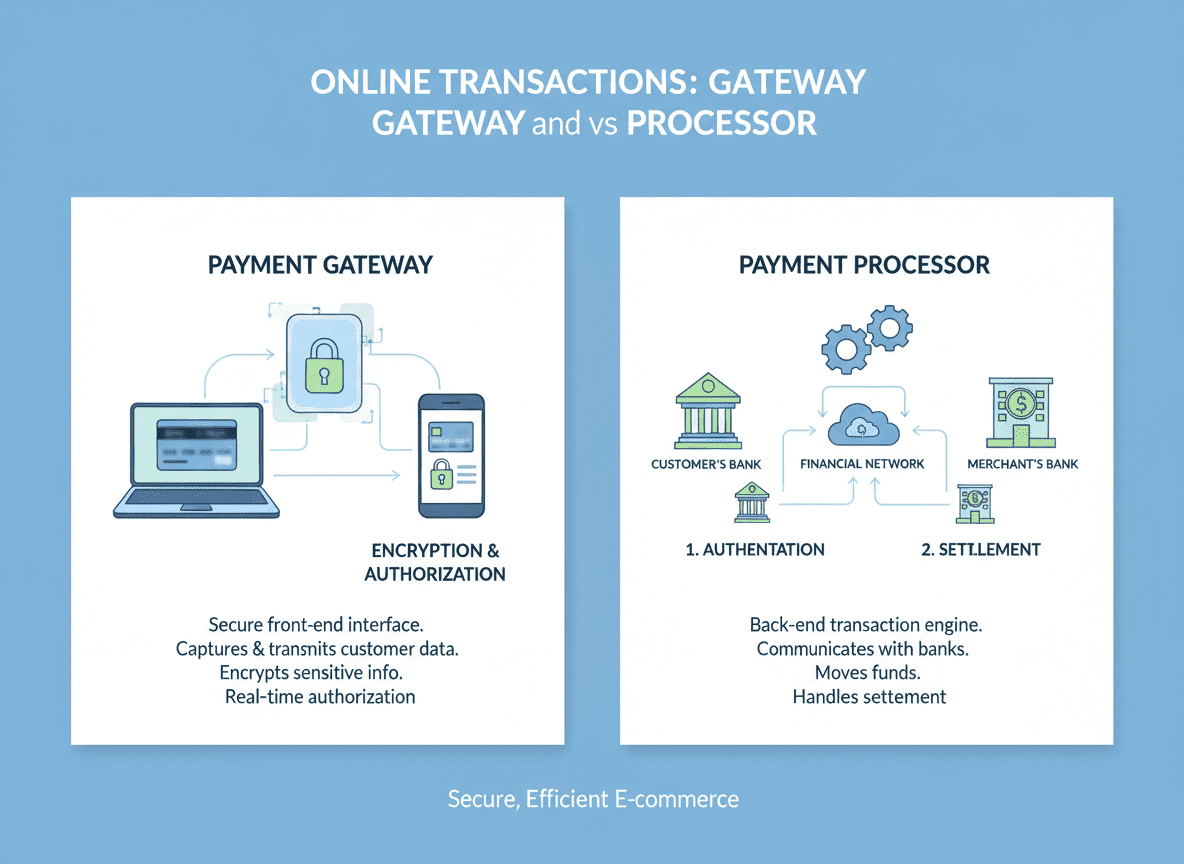
A payment gateway acts as the secure front-end interface that captures and transmits customer payment details from a website or app to the processing network. It encrypts sensitive information like card numbers or digital wallet data and authorizes transactions in real time.
In contrast, a payment processor handles the behind-the-scenes financial settlement, communicating with banks, card networks, and merchants to move actual funds. Processors manage approvals, risk assessment, and fund transfers after the gateway’s initial handoff.
Both are essential, but the gateway focuses on customer-facing security while the processor deals with backend banking logistics.
How Payment Gateways Operate
Payment gateways kick off the transaction when a shopper clicks “pay.” They collect details via forms or hosted pages, apply encryption like SSL/TLS, and perform basic fraud checks such as CVV matching or velocity limits.
The gateway then forwards encrypted data to the processor or acquiring bank. Examples include Stripe’s checkout or PayPal’s redirect flow. Popular types—hosted, self-hosted, or API-integrated—offer flexibility for seamless user experiences.
Gateways prioritize speed and trust, often integrating 100+ methods like cards, UPI, Apple Pay, and BNPL options.
How Payment Processors Function
Processors receive the gateway’s authorized request and dive into financial verification. They route queries through card networks (Visa, Mastercard) to the customer’s issuing bank, confirming funds availability and flagging fraud via tools like AVS or 3D Secure.
Once approved, processors hold funds in a temporary reserve before batch-settling them into the merchant’s account, typically daily or weekly. They also manage chargebacks, refunds, and compliance reporting.
Providers like Worldpay or Braintree excel here, often bundling processor and gateway services for simplicity.
Key Functional Differences
Gateways and processors differ sharply in scope and timing.
| Aspect | Payment Gateway | Payment Processor |
|---|---|---|
| Role | Front-end data capture and encryption | Backend fund authorization and settlement |
| Timing | Real-time during checkout | Post-authorization (minutes to days) |
| Tech Focus | User interface, integrations | Bank communications, risk management |
| Examples | Stripe Elements, Razorpay Checkout | Adyen Processor, Chase Paymentech |
| Merchant Interaction | Website/app embeds | Account setup with acquiring banks |
Gateways rarely touch funds directly; processors do the heavy lifting for money movement.
Technical Architecture Breakdown
Gateways integrate via APIs or plugins into platforms like Shopify or WooCommerce, using iframes for PCI-safe data handling. They tokenize card data—replacing it with unique IDs—to minimize breach risks.
Processors operate in a closed network of financial institutions, adhering to ISO 8583 standards for message routing. They support multi-acquirer models, splitting volume across banks for better rates and uptime.
Together, they form the “payment stack”: gateway for acquisition, processor for fulfillment.
Security and Compliance Contrasts
Gateways bear PCI DSS Level 1 burdens for data transmission, employing end-to-end encryption and tokenization vaults. They implement 3D Secure 2.0 for liability shifts on disputed transactions.
Processors focus on settlement security, with segregated accounts to prevent commingling funds. They conduct deeper fraud analytics using machine learning on transaction histories and geolocation.
Merchants using integrated providers (gateway + processor) simplify compliance, as one entity handles both PCI scopes.
Pricing Model Variations
Gateway fees emphasize transaction volume: typically 1.5-3.5% + fixed fee per successful payment, plus setup or monthly costs for premium features like fraud tools.
Processors charge interchange (bank-set, 1.5-2.5%) plus markup, often via interchange-plus models for transparency. They add chargeback fees ($15-30) and may require rolling reserves (5-10% of sales held for disputes).
Bundled solutions like Square combine both at flat rates, ideal for small businesses, while separates allow negotiation for high-volume deals.
Popular Providers Compared
Many companies offer both services, blurring lines for convenience.
- Stripe: Gateway with built-in processing; developer-friendly for global scaling.
- PayPal: Gateway-focused but processes via partners; excels in buyer protection.
- Adyen: Unified gateway-processor for enterprises like Uber, with omnichannel support.
- Razorpay: India-centric gateway-processor duo, strong on UPI and local methods.
- Authorize.net: Pure gateway that pairs with various processors.
Pure-play processors like First Data cater to custom needs, often requiring a separate gateway.
When Businesses Need Each
Small e-commerce sites favor all-in-one providers for quick setup and lower friction. Gateways shine for user experience tweaks, like one-click checkouts reducing abandonment by 20-30%.
Enterprises opt for separated or modular stacks: custom gateways for branding, specialist processors for optimized routing across 50+ countries. High-risk sectors (gaming, crypto) demand processors with advanced underwriting.
Hybrid models dominate 2026, with gateways increasingly embedding processor logic via APIs.
Integration Challenges
Gateway setup is straightforward—API keys and sandbox testing take hours. Self-hosted versions require developer oversight for PCI SAQ-A compliance.
Processor onboarding involves merchant accounts, underwriting (1-7 days), and bank verifications. Multi-processor redundancy prevents downtime but adds complexity.
Tools like Plaid or Finix abstract these, letting developers plug in either without deep fintech knowledge.
Performance Metrics to Watch
Gateways track approval rates (aim for 95%+), latency (<2 seconds), and abandonment. Downtime here kills sales directly.
Processors monitor settlement speed, chargeback ratios (<1%), and payout reliability. False declines hurt: gateways optimize with retry logic; processors with smarter routing.
Dashboards unify insights, with AI flagging trends like regional fraud spikes.
Benefits of Bundled vs. Separate Solutions
Bundled (e.g., Stripe) streamlines reconciliation—one report for everything—and cuts integration time by 70%. Fault isolation is harder, though.
Separate setups offer flexibility: swap gateways for better UX without re-underwriting processors. They suit global ops, negotiating rates per corridor (US vs. India).
Cost savings emerge at scale—processors offer volume tiers unavailable in bundles.
Real-World Use Cases
A Shopify store uses Razorpay’s gateway for UPI checkouts, routing to their processor for instant settlements in India. Conversion jumps due to local methods.
An enterprise like Netflix employs Adyen’s unified stack for 190 countries, balancing gateway customization with processor efficiency for subscriptions.
Freelancers pick PayPal’s gateway-processor combo for instant payouts, skipping bank delays.
Common Misconceptions Cleared
Myth: They’re interchangeable. Reality: No gateway, no secure data intake; no processor, no fund access.
Myth: All providers do both equally. Check SLAs—gateway uptime is customer-facing; processor reliability affects cash flow.
Myth: Cheaper always wins. Prioritize approvals over rock-bottom fees; 1% decline rate costs more than 0.5% extra markup.
Future Evolutions
Embedded finance blurs boundaries further—gateways like Stripe process directly in apps, bypassing traditional processors. Real-time payments (RTP) via Visa Direct make settlement instant.
AI unifies roles: predictive gateways pre-authorize, processors auto-route for lowest cost. Crypto and CBDCs challenge both, demanding new compliance like MiCA in Europe.
Open banking APIs let gateways query processor data dynamically, personalizing offers.
Choosing Your Stack Wisely
Assess volume: under $10K/month? Bundled gateway-processor suffices. Scaling? Modular for optimization.
Test with sandboxes: simulate declines, internationals. Factor geography—India needs UPI gateways; US favors cards.
Negotiate SLAs: 99.99% uptime, sub-1% disputes. Start small, iterate based on analytics.
Best Practices for Optimization
Diversify methods via gateways to match audiences. Monitor unified KPIs across both.
A/B test flows: gateway UI tweaks lift conversions. Use tokenization religiously for recurring revenue.
Annual audits ensure compliance amid regs like PSD3. Partner with PCI-savvy experts for peace of mind.
Mastering these differences empowers smarter decisions, fueling growth in a payments-driven economy.