
Payment gateways form the backbone of online transactions, securely linking shoppers, merchants, and banks to enable seamless digital payments. They handle everything from card swipes to digital wallets, making e-commerce possible without the risks of direct fund handling.
Defining Payment Gateways
A payment gateway is essentially a digital storefront’s secure checkout counter. When a customer selects “pay now,” the gateway captures details like card numbers or UPI IDs, encrypts them, and sends them to banks for approval. This process mimics a physical POS terminal but operates entirely online, supporting cards, net banking, wallets, and emerging methods like BNPL.
It acts as an intermediary, ensuring merchants never touch raw sensitive data. Gateways integrate with websites, apps, or even social commerce platforms, processing billions in transactions daily across the globe.
Step-by-Step Workflow
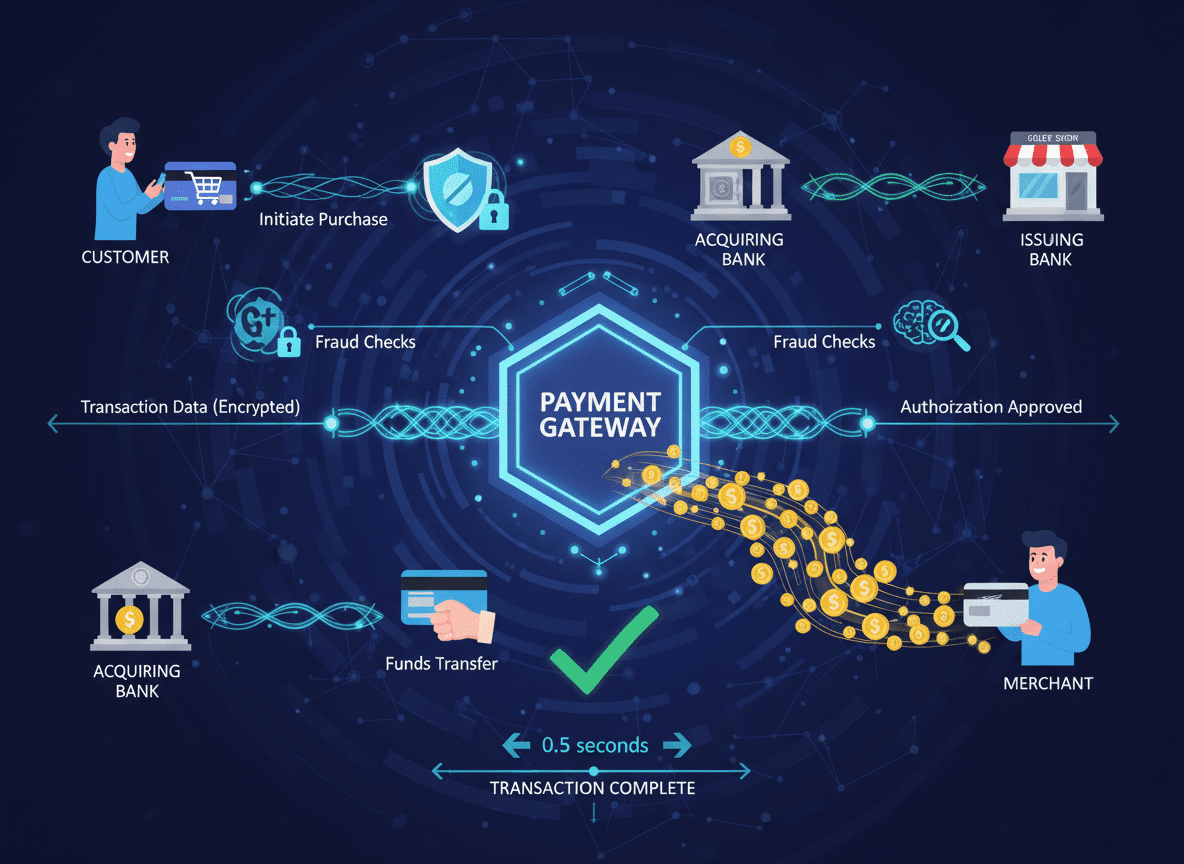
The transaction flow unfolds in milliseconds. First, the customer enters payment info on your site. The gateway encrypts it using SSL/TLS and performs initial fraud scans, like checking for unusual spending patterns.
Next, it pings the merchant’s acquiring bank, which routes the request through card networks (Visa, Mastercard) to the customer’s issuing bank. Approval or decline returns instantly: green light means funds are reserved; red triggers an error like “insufficient balance.” Settlement batches funds into your account overnight or daily.
Advanced steps include 3D Secure protocols, where an OTP or biometric check adds authentication layers, slashing chargeback risks.
Main Gateway Types
Four primary types cater to varying business scales and tech savvy. Hosted gateways redirect users to a provider’s page for payment—simple but less branded. Self-hosted ones keep everything on your site, demanding strong security from you.
API or semi-integrated gateways blend both, letting you design the frontend while the provider secures the backend. Local bank integrations suit basic needs, often redirecting straight to bank portals.
Hosted suits beginners; API types power sophisticated platforms like marketplaces.
| Type | Key Trait | Ideal Use Case |
|---|---|---|
| Hosted | Off-site checkout | Quick setups for small shops |
| Self-Hosted | On-site forms | Branded, seamless experiences |
| API-Hosted | Custom integrations | Apps and enterprises |
| Local Bank | Direct redirects | Regional, low-volume sales |
Essential Features
Top gateways pack security tools like tokenization, swapping card data for unique IDs to thwart hacks. Fraud detection uses AI to flag anomalies, such as mismatched IP locations or rapid small purchases.
Multi-currency conversion handles global sales effortlessly, while payment method diversity—over 100 options including Apple Pay, Google Pay, and crypto—widens your audience. Dashboards offer real-time insights into success rates, refunds, and revenue trends.
Recurring billing automates subscriptions, and webhooks notify your system of events like disputes instantly.
Leading Providers Overview
PayPal stands out for its universal trust and buyer protection, perfect for international freelancers. Stripe shines in developer-friendly APIs, fueling startups from Shopify stores to ride-sharing apps.
Adyen unifies online and in-store payments for giants like eBay, while Razorpay dominates India with UPI and Aadhaar Pay support. Square offers all-in-one for brick-and-mortar transitioning online.
Each excels in niches: choose based on your geography and volume.
Business and Customer Wins
Merchants gain from lower cart abandonment—frictionless checkouts convert 20-30% better. They scale globally without banking partnerships, cutting setup hassles and compliance headaches.
Customers love speed: one-click payments, familiar methods, and visible security badges build confidence. Localized options, like regional languages or wallets, reduce drop-offs in emerging markets.
Overall, gateways democratize commerce, letting solopreneurs rival corporations.
Security Must-Haves
PCI DSS compliance is table stakes—Level 1 means rigorous audits and data firewalls. End-to-end encryption ensures no leaks, while EMV 3D Secure mandates extra verification for high-value buys.
Tokenization and point-to-point encryption render stolen data useless. Providers monitor 24/7 with machine learning, adapting to new threats like account takeovers.
Merchants minimize liability by never storing cards themselves.
Picking the Perfect Fit
Start with your needs: transaction volume, international reach, and platform (WooCommerce? Custom app?). Low-volume shops prioritize ease; enterprises demand uptime SLAs above 99.99%.
Scrutinize fees—interchange-plus models beat flat rates for transparency. Test demos for mobile responsiveness and local methods. Factor in support: 24/7 chat trumps email for urgent issues.
Pilot with a sandbox, then migrate during low-traffic periods.
Seamless Integration Guide
Hosted types plug in via links or buttons—no code needed. Self/API gateways require embedding SDKs: grab API keys, add checkout forms (like Stripe Elements iframes), and test sandboxes.
E-commerce platforms like Magento offer one-click plugins for dozens of gateways. Post-launch, configure webhooks for notifications and analytics for optimization.
Expect 1-2 weeks for full rollout, faster with pre-built integrations.
Pricing Breakdown
Costs layer up: one-time setup ($0-500), monthly fees ($10-100), and per-transaction cuts (1.4-3.5% + $0.20-0.30). High-volume gets tiered discounts; internationals add 1-2% FX fees.
Chargebacks cost $15-30 each; premium fraud tools justify extras. Interchange-plus (raw bank rate + markup) saves long-term versus bundled merchant accounts.
SMBs often net cheaper with no-setup options.
Pitfalls and Fixes
High decline rates? Implement retry logic and clear error messages. Cross-border friction? Enable dynamic currency conversion.
Compliance overwhelm? Shift to providers handling PCI. Seasonal spikes? Scale with auto-load balancing.
Proactive monitoring and A/B testing checkouts keep issues at bay.
Emerging Trends
Embedded payments weave gateways into non-ecom apps, like payroll platforms. Real-time payouts via networks like Visa Direct speed merchant cash flow.
Biometrics and invisible authentication phase out passwords; crypto ramps up with stablecoins. BNPL surges, with gateways partnering Klarna or Afterpay.
AI personalizes methods—UPI for Indians, cards for others—driving conversions.
Merchant Best Practices
Diversify methods to match audiences. Optimize mobile checkouts, as 60%+ traffic is handheld.
Track KPIs: aim for 95%+ approvals, under 1% fraud. Use split testing for flows.
Communicate security transparently. Review providers annually amid regs like PSD3.
Regular audits ensure peak performance.